AF074E Basic Electrical Laboratory Educational Equipment Electrical Engineering Training Equipment
1. Product Introduction
1.1 Product Description
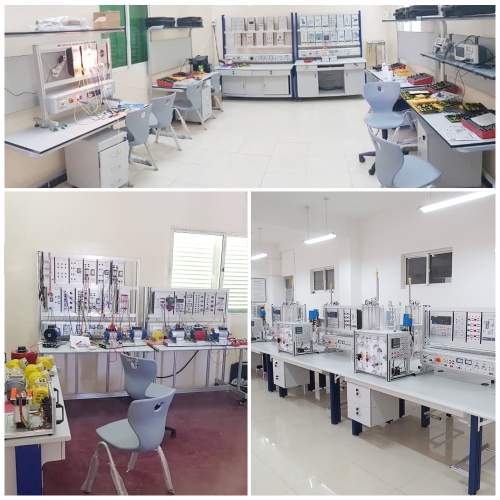
AF074E Basic Electrical Training Device is a set of experimental equipment specially used for teaching courses such as "Basic Theory of Electrical Engineering" and "Electrical Technology". It adopts advanced design concepts, and the experimental panels can be replaced freely to meet different training requirements. The experimental instruments are of high precision, and all power and measuring instruments are equipped with reliable personal safety protection systems to ensure the safety of use.
This training device is suitable for teaching multiple courses and has good scalability, which can be extended to other training contents. The front of the experimental hanging box is equipped with schematic diagrams and symbols to help students better understand circuit design. The experimental circuit adopts the unit circuit mode design, and each unit circuit is built based on the basic circuit principle, which is convenient for students to master various electrical training contents.
In short, AF074E Basic Electrical Training Device is a set of comprehensive, safe, reliable and easy-to-use electrical experimental teaching equipment that can meet the teaching needs of multiple courses, help students deeply understand the circuit principles, and improve their operating ability.
1.2 Product Features
1. Advanced design: The experimental bench adopts advanced design concepts, and the experimental panels can be replaced freely to meet different training requirements.
2. High-precision instruments: The experimental instruments are of high precision, and all power and instruments have reliable personal safety protection systems.
3. Wide applicability: It is suitable for the teaching of courses such as "Basic Theory of Electrical Engineering" and "Electrical Technology". Due to its good expansion capability, it can also be used for other training content.
4. Clear schematic diagrams and symbols: The front of the experimental hanging box is equipped with schematic diagrams and symbols to help students better understand circuit design.
5. Unit circuit mode: The experimental circuit is designed in unit circuit mode. Each unit circuit is built based on the basic circuit principle, which is convenient for students to master various electrical training contents.
2. Technical specifications
2.1 Technical parameters
Nominal voltage: single-phase three-wire 220V±10% 50Hz
Working environment conditions: ambient temperature -10℃~+40℃, relative humidity < 85% (25℃).
2.2 Dimensions and weight
Dimensions: 1600mm×400mm×950mm
Weight: <160kg

3.Product component names and function introduction
3.1 Product main part
NO. Name Qty.
1 Kirchhoff theorem module 1
2 Capacitor module 1
3 Resistor star-delta module 1
4 Potentiometer module 1
5 DC voltage and current module 1
6 Superposition theorem module 1
7 Inductor module 1
8 Reciprocity law module 1
9 Thevenin theorem module 1
10 Ohm's law module 1
11 Resistor module
12 Voltage divider and current shunt module 1
13 Circuit breaker 1
14 Power indicator light 1
15 Emergency stop switch 1
16 AC power module 1
17 European two-position socket AC230V 2
18 Constant current source 1
19 DC power module 1
20 DC voltmeter and ammeter module 1
3.2 Product accessories
NO. Name Qty.
1 Digital multimeter 1
2 Digital inductance and capacitance meter 1
3 4mm electrical safety cable 1 meter double-ended yellow 10
4 4mm electrical safety cable 1 meter double-ended red 10
5 U-shaped plug red 5
6 U-shaped plug black 5
7 4mm electrical safety cable 1 meter double-ended black 5
8 4mm electrical safety cable 1 meter double-ended two-color 5
9 4mm electrical safety cable 1 meter double-ended green 10
10 4mm electrical safety cable 1 meter double-ended blue 5
11 European power cord 2
12 P-shaped adapter cable 1
4. Product teaching experiment list (see the experiment guide for details)
(1) Experiment 1 Verification of Ohm's law
(2) Experiment 2 Resistance characteristics
(3) Experiment 3 Capacitance characteristics
(4) Experiment 4 Inductance characteristics
(5) Experiment 5 Verification of Kirchhoff's law
(6) Experiment 6 Verification of voltage division and current shunting characteristics of resistors
(7) Experiment 7 Verification of star-delta equivalent conversion of resistors
(8) Experiment 8 Power calculation
(9) Experiment 9 Verification of superposition principle
(10) Experiment 10 Verification of Thevenin's theorem and Norton's theorem
(11) Experiment 11 Verification of reciprocity theorem
(12) Experiment 12 Node equations
(13) Experiment 13 Loop equations



 Login
Login  Inquiry List